
Skip to main content Accessibility help
×
  • Cited by 1
    • Show more authors
    • Open Access
      You have digital access to this book
    • Select format
    • Publisher:
      Cambridge University Press
      Publication date:
      19 December 2025
      08 January 2026
      ISBN:
      9781009492379
      9781009492348
      Open access funder:
      Charles University, Faculty of Mathematics and Physics
      Creative Commons:
      Creative Common License - CC Creative Common License - BY Creative Common License - NC
      This content is Open Access and distributed under the terms of the Creative Commons Attribution licence CC-BY-NC 4.0.
      https://creativecommons.org/creativelicenses
      Dimensions:
      (244 x 170 mm)
      Weight & Pages:
      0.84kg, 368 Pages
      Dimensions:
      Weight & Pages:
    Open Access
    You have digital access to this book
    Selected: Digital
    View content
    Add to cart View cart Buy from Cambridge.org

    Book description

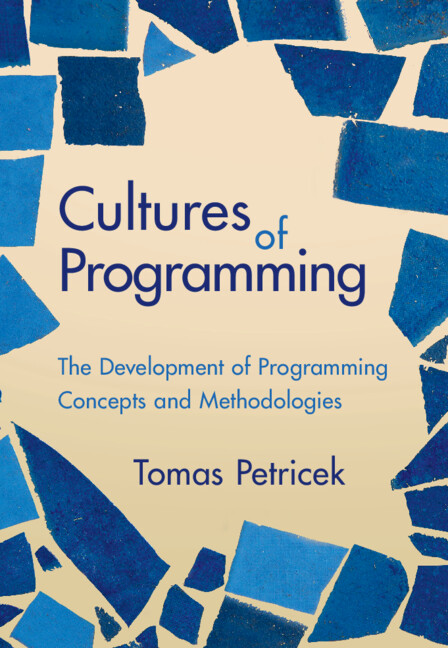
    What defines a correct program? What education makes a good programmer? The answers to these questions depend on whether programs are seen as mathematical entities, engineered socio-technical systems or media for assisting human thought. Programmers have developed a wide range of concepts and methodologies to construct programs of increasing complexity. This book shows how those concepts and methodologies emerged and developed from the 1940s to the present. It follows several strands in the history of programming and interprets key historical moments as interactions between five different cultures of programming. Rooted in disciplines such as mathematics, electrical engineering, business management or psychology, the different cultures of programming have exchanged ideas and given rise to novel programming concepts and methodologies. They have also clashed about the nature of programming; those clashes remain at the core of many questions about programming today. This title is also available as Open Access on Cambridge Core.

    Reviews

    ‘The book succeeds not only as a readable story that subject matter enthusiasts can revel in, but it also provides the tools to resolve ingrained disagreements between colleagues. For it is quite possible that your manager is not hopelessly stuck in the past when he characterizes testing as a phase; he may be starting from a different assumption regarding the role of testing in the process. And perhaps your colleague who used to study mathematics is not a hopeless theorist, but his view of what good code looks like is shaped by notions of elegance rather than readability. The fact that we all write Java or C# turns out to be no guarantee that we speak the same language.’

    Karl van Heijster Source: Boekenkrant

    ‘Petricek's adoption of a different lens to analyze the history and evolution of programming - namely, the culture of programming - creates reader interest and encourages detachment from the purely technical aspects of programming by entertaining the notion that programming is inextricably linked to our own humanity. … useful for historians and others who would like to explore the topic of programming but do not wish to be constrained by a specific programming paradigm and its inevitable technicalities. … Recommended.’

    L. Benedicenti Source: Choice

    Refine List

    Actions for selected content:

    Select all | Deselect all
    • View selected items
    • Export citations
    • Download PDF (zip)
    • Save to Kindle
    • Save to Dropbox
    • Save to Google Drive

    Save Search

    You can save your searches here and later view and run them again in "My saved searches".

    Please provide a title, maximum of 40 characters.
    ×

    Contents

    Full book PDF
    • Frontmatter
      pp i-iv
    • Contents
      pp v-viii
    • Preface
      pp ix-xi
    • Acknowledgements
      pp xii-xiv
    • 1 - Introduction
      pp 1-32
    • 2 - Mathematisation of Programming
      pp 33-76
    • 3 - Interactive Programming
      pp 77-131
    • 4 - Software Engineering
      pp 132-190
    • 5 - Programming with Types
      pp 191-235
    • 6 - Object-Oriented Programming
      pp 236-284
    • 7 - Conclusion: Cultures of Programming
      pp 285-308
    • References
      pp 309-331
    • Index
      pp 332-352

    Metrics

    Altmetric attention score

    Full text views

    Total number of HTML views: 0
    Total number of PDF views: 0 *
    Loading metrics...

    Book summary page views

    Total views: 0 *
    Loading metrics...

    * Views captured on Cambridge Core between #date#. This data will be updated every 24 hours.

    Usage data cannot currently be displayed.

    Accessibility standard: Missing or limited accessibility features

    Why this information is here

    This section outlines the accessibility features of this content - including support for screen readers, full keyboard navigation and high-contrast display options. This may not be relevant for you.

    Accessibility Information

    The PDF of this book is known to have missing or limited accessibility features. We may be reviewing its accessibility for future improvement, but final compliance is not yet assured and may be subject to legal exceptions. If you have any questions, please contact accessibility@cambridge.org.

    Content Navigation
    Table of contents navigation

    Allows you to navigate directly to chapters, sections, or non‐text items through a linked table of contents, reducing the need for extensive scrolling.

    Index navigation

    Provides an interactive index, letting you go straight to where a term or subject appears in the text without manual searching.