

Overview
- This book is open access, which means that you have free and unlimited access
- In depth, combines foundational theory with practical examples
- Multidisciplinary in set-up
- Comprehensive in approach
Buy print copy
About this book
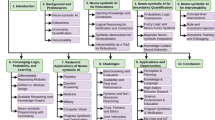
This open access book investigates the renewed role of models in the solutions supporting our organisational reality. With AI and other advanced IT as digital actors, we are more and more delegating decisions that help to create new social reality to autonomous artificial systems. This raises several critical questions, for example, how can we keep our skills in building and discussing abstractions to create a unified view of the existing and emerging social and digital reality? How can we build autonomous information systems using these abstractions that we understand and trust, i.e., systems that reflect our values, and that are semantically transparent and able to explain their decisions? In recent years, the main focus on AI has been machine learning and generative AI with limited explainability. In the future, AI will combine traditional symbolic techniques (including conceptual modelling and knowledge graphs) with sub-symbolic techniques (neural networks) in neuro-symbolic computing. Supporting modelling of the people, by the people, for the people becomes, in this situation, necessary to empower humans to stay as active actors in the loop of AI-enhanced decision-making and action. To understand how work in neuro-symbolic computing can progress, we should clarify what it means for both the symbolic and machine learning models to be good. What is the quality of the different types of models, and how do these notions of quality align with human notions of quality? The quality of conceptual models (as an example of symbolic models) has been investigated for many decades. In this book, we will combine works from semiotics, information systems, conceptual modelling, AI and neuroscience to investigate the quality of models and data for both human and machine actors, laying a firm foundation for the future converging neuro-symbolic computing.
Table of contents (7 chapters)
-
Front Matter
-
Back Matter
Authors and affiliations
About the author
John Krogstie holds a PhD (1995) and a MSc (1991) in information systems from the Norwegian University of Science and Technology (NTNU), where he is currently a full professor in information systems at the computer science department (IDI). John Krogstie is the Norwegian representative and previously Vice-Chair for IFIP TC8 and was chair of IFIP WG 8.1 on information system design and evaluations (2010-2015). His research interests are information systems development, information systems engineering, quality of models and modelling languages, neuro-conceptualization, eGovernment, sustainable smart cities and sustainable digitalization in general. He has published more than 380 refereed papers in journals, books and archival proceedings since 1991.
Accessibility information
PDF accessibility summary
This PDF has been created in accordance with the PDF/UA-1 standard to enhance accessibility. It includes screen reader support, descriptions for Non-text content (such as images and graphs), bookmarks for easy navigation, keyboard-friendly links and forms, and searchable, selectable text. We recognise the importance of accessibility and welcome queries about accessibility for any of our products. If you have a question or an access need, please get in touch with us via https://www.springernature.com/gp/info/accessibility Please Note that a more accessible version of this eBook is available as an EPUB.
EPUB accessibility summary
This EPUB is designed with accessibility in mind, aiming to meet the EPUB Accessibility 1.1 and WCAG 2.2 Level AA standards. It features a navigable table of contents, structured headings, and alternative text for images, ensuring smooth, intuitive navigation and comprehension. The text is reflowable and resizable, with sufficient contrast. We recognize the importance of accessibility, and we welcome queries about accessibility for any of our products. If you have a question or an access need, please get in touch with us via https://www.springernature.com/gp/info/accessibility
Bibliographic information
Book title: Quality of Models for Man and Machine
Book subtitle: A Foundation for Neuro-Symbolic Computing
Authors: John Krogstie
DOI: https://doi.org/10.1007/978-3-032-42129-6
Publisher: Springer Cham
eBook packages: Computer Science, Computer Science (R0)
Copyright information: The Editor(s) (if applicable) and The Author(s) 2027
Hardcover ISBN: 978-3-032-42128-9Published: 01 November 2026
Softcover ISBN: 978-3-032-42131-9Due: 15 November 2027
eBook ISBN: 978-3-032-42129-6Published: 31 October 2026
Edition number: 1
Number of pages: XX, 323
Number of illustrations: 34 b/w illustrations, 87 illustrations in colour
Topics: Information Systems and Communication Service, Software Engineering/Programming and Operating Systems, Artificial Intelligence, Simulation and Modeling, Computer Applications, Semiotics