

Overview
- Considers the practical and material dimensions
- This book is Open Access, which means that you have free and unlimited access
- Adopts a perspective that integrates the histories of medicine
- Examines Sanctorius and his work in the broader perspective of processes of knowledge transformation
Buy print copy
About this book
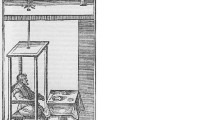
This open access book offers new insights into the Venetian physician Sanctorius Sanctorius (1561–1636) and into the origins of quantification in medicine. At the turn of the seventeenth century, Sanctorius developed instruments to measure and quantify physiological change. As trivial as the quantitative assessment of health issues might seem to us today – in times of fitness trackers and smart watches – it was highly innovative at that time. With his instruments, Sanctorius introduced quantitative research into the field of physiology. Historical accounts of Sanctorius and his work tend to tell the story of a genius who, almost out of the blue, invented a new medical science, based on measurement and quantification, that profoundly influenced modernity. Abandoning the “genius narrative,” this book examines Sanctorius and his work in the broader perspective of processes of knowledge transformation in early modern medicine. It is the first systematic study to include the entire rangeof the physician’s intellectual and practical activities. Adopting a material culture perspective, the research draws on the contemporary reconstruction of Sanctorius’s most famous instrument: the Sanctorian weighing chair. And here it departs from past studies that focus mainly on Sanctorius’s thinking rather than on his making and doing. The book also re-evaluates Sanctorius’s role in the wider process of the early transformation of medical culture in the early modern period, a process that ultimately led to the abandonment of Galenic medicine and to the introduction of a new medical science, based on the use of quantification and measurement in medical research. The book is therefore an important contribution to the history of medicine and historical epistemology aimed at historians of science and philosophy.
Table of contents (8 chapters)
-
Front Matter
-
Back Matter
Authors and affiliations
About the author
Teresa Hollerbach studied History of Science and History of Technology in Berlin and Florence. She completed her PhD at the Max Planck Institute for the History of Science and the Technical University of Berlin with a dissertation on the Venetian physician Sanctorius Sanctorius (1561–1636) and his role in the context of the process of the emergence and establishment of methods of quantification in medicine. Afterwards, she researched the role of the Max Planck Institute for Human Development in the pedophile debate in West Germany of the 1960s and 1970s. Processes of scientific knowledge production and transformation, the epistemology of practical knowledge, and material culture studies are her main research interests. Since 2022, she works in the field of science communication.
Accessibility information
PDF accessibility summary
This PDF does Not fully comply with PDF/UA standards but does include limited screen reader support, descriptions for Non-text content (such as images and graphs), bookmarks for easy navigation, and searchable, selectable text. Users of assistive technologies may experience difficulty navigating or interpreting content in this document. We recognise the importance of accessibility and welcome queries about accessibility for any of our products. If you have a question or an access need, please get in touch with us via https://www.springernature.com/gp/info/accessibility
EPUB accessibility summary
This EPUB has been designed with accessibility in mind and aims to meet the EPUB Accessibility 1.0 and WCAG 2.2 Level AA standards. Its features include Alternative Text descriptions for images and other Non-text content, as well as rich navigation that is compatible with screen readers. We recognise the importance of accessibility and welcome queries about accessibility for any of our products. If you have a question or an access need, please get in touch with us via https://www.springernature.com/gp/info/accessibility
Bibliographic information
Book title: Sanctorius Sanctorius and the Origins of Health Measurement
Authors: Teresa Hollerbach
DOI: https://doi.org/10.1007/978-3-031-30118-6
Publisher: Springer Cham
eBook packages: History, History (R0)
Copyright information: The Editor(s) (if applicable) and The Author(s) 2023
Hardcover ISBN: 978-3-031-30117-9Published: 19 May 2023
Softcover ISBN: 978-3-031-30120-9Published: 19 May 2023
eBook ISBN: 978-3-031-30118-6Published: 18 May 2023
Edition number: 1
Number of pages: XXII, 327
Number of illustrations: 1 b/w illustrations
Topics: History of Science, Philosophy of Science, History of Medicine, History of Technology, Epistemology